

Harmonic Radar Finds Hidden Electronics
For as long as small, hidden radio transmitters have existed, people have wanted a technology to detect them. One of the more effective ways to find hidden electronics is the nonlinear junction detector, which illuminates the area under investigation with high-frequency radio waves. Any P-N semiconductor junctions in the area will emit radio waves at harmonic frequencies of the original wave, due to their non-linear electronic response. If, however, you suspect that the electronics might be connected to a dangerous device, you’ll want a way to detect them from a distance. One solution is harmonic radar (also known as nonlinear radar), such as this phased-array system, which detects and localizes the harmonic response to a radio wave.
One basic problem is that semiconductor devices are very rarely connected to antennas optimized for the transmission of whatever harmonic you’re looking for, so the amount of electromagnetic radiation they emit is extremely low. To generate a detectable signal, a high-power transmitter and a very high-gain receiver are necessary. Since semiconductor junctions emit stronger lower harmonics, this system transmits in the 3-3.2 GHz range and only receives the 6-6.4 GHz second harmonic; to avoid false positives, the transmitter provides 28.8 decibels of self-generated harmonic suppression. To localize a stronger illumination signal to a particular point, both the transmit and receive channels use beam-steering antenna arrays.
In testing, the system was able to easily detect several cameras, an infrared sensor, a drone, a walkie-talkie, and a touch sensor, all while they were completely unpowered, at a range up to about ten meters. Concealing the devices in a desk drawer increased the ranging error, but only by about ten percent. Even in the worst-case scenario, when the system was detecting multiple devices in the same scene, the ranging error never got worse than about 0.7 meters, and the angular error was never worse than about one degree.
For a refresher on the principles of the technology, we’ve covered nonlinear junction detectors before. While the complexity of this system seems to put it beyond the reach of amateurs, we’ve seen some equally impressive homemade radar systems before.


I went to the local grocery store at lunch today to buy my favorite person some flowers for Valentine's day and I spent far too much time and money there. I now have some new flower subjects for this weekend


Storing Image Data As Analog Audio
Ham radio operators may be familiar with slow-scan television (SSTV) where an image is sent out over the airwaves to be received, decoded, and displayed on a computer monitor by other radio operators. It’s a niche mode that isn’t as popular as modern digital modes like FT8, but it still has its proponents. SSTV isn’t only confined to the radio, though. [BLANCHARD Jordan] used this encoding method to store digital images on a cassette tape in a custom-built tape deck for future playback and viewing.
The self-contained device first uses an ESP32 and its associated camera module to take a picture, with a screen that shows the current view of the camera as the picture is being taken. In this way it’s fairly similar to any semi-modern digital camera. From there, though, it starts to diverge from a typical digital camera. The digital image is converted first to analog and then stored as audio on a standard cassette tape, which is included in the module in lieu of something like an SD card.
To view the saved images, the tape is played back and the audio signal captured by an RP2040. It employs a number of methods to ensure that the reconstructed image is faithful to the original, but the final image displays the classic SSTV look that these images tend to have as a result of the analog media. As a bonus feature, the camera can use a serial connection to another computer to offload this final processing step.
We’ve been seeing a number of digital-to-analog projects lately, and whether that’s as a result of nostalgia for the 80s and 90s, as pushback against an increasingly invasive digital world, or simply an ongoing trend in the maker space, we’re here for it. Some of our favorites are this tape deck that streams from a Bluetooth source, applying that classic cassette sound, and this musical instrument which uses a cassette tape to generate all of its sounds.

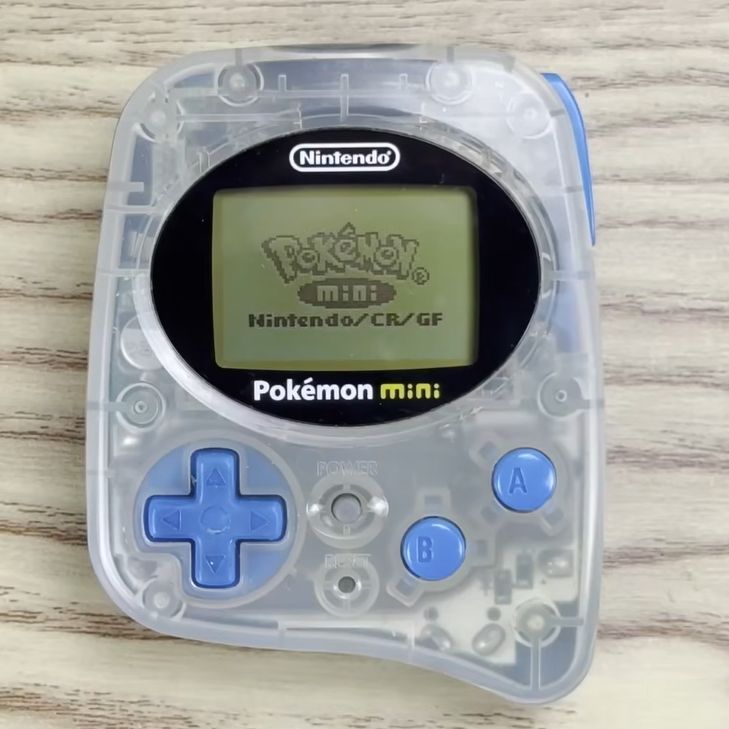
Exploring Homebrew for the Pokémon Mini
Originally only sold at the Pokémon Center New York in late 2001 for (inflation adjusted) $80, the Pokémon Mini would go on to see a release in Japan and Europe, but never had more than ten games produced for it. Rather than Game Boy-like titles, these were distinct mini games that came on similarly diminutive cartridges. These days it’s barely remembered, but it can readily be used for homebrew titles, as [Inkbox] demonstrates in a recent video.
Inside the device is an Epson-manufactured 16-bit S1C88 processor that runs at 4 MHz and handles basically everything, including video output to the monochrome 96×64 pixel display. System RAM is 4 kB of SRAM, which is enough for the basic games that it was designed for.
The little handheld system offered up some capabilities that even the full-sized Game Boy couldn’t match, such as a basic motion sensor in the form of a reed relay. There’s also 2 MB of ROM space directly addressable without banking.
Programming the device is quite straightforward, not only because of the very accessible ISA, but also the readily available documentation and toolchain. This enables development in C, but in the video assembly is used for the added challenge.
Making the screen tiles can be done in an online editor that [Inkbox] also made, and the game tested in an emulator prior to creating a custom cartridge that uses an RP2040-based board to play the game on real hardware. Although a fairly obscure gaming handheld, it seems like a delightful little system to tinker with and make more games for.
youtube.com/embed/48Mg4YMJGIk?…

Questo sito web utilizza cookie tecnici e di sessione. Proseguendo la navigazione su questo sito, accetti l'utilizzo dei cookie.
Jerry 🦙💝🦙
in reply to Krypt3ia • • •Krypt3ia
in reply to Jerry 🦙💝🦙 • • •