

Is That Ancient Reel Of PLA Any Good?
When it comes to knowledge there are things you know as facts because you have experienced them yourself or had them verified by a reputable source, and there are things that you know because they are common knowledge but unverified. The former are facts, such as that a 100mm cube of water contains a litre of the stuff, while the latter are received opinions, such as the belief among Americans that British people have poor dental care. The first is a verifiable fact, while the second is subjective.
In our line there are similar received opinions, and one of them is that you shouldn’t print with old 3D printing filament because it will ruin the quality of your print. This is one I can now verify for myself, because I was recently given a part roll of blue PLA from a hackerspace, that’s over a decade old. It’s not been stored in a special environment, instead it’s survived a run of dodgy hackerspace premises with all the heat and humidity that’s normal in a slightly damp country. How will it print?
It Ain’t Stringy
In the first instance, looking at the filament, it looks like any other filament. No fading of the colour, no cracking, if I didn’t know its age it could have been opened within the last few weeks. It loads into the printer, a Prusa Mini, fine, it’s not brittle, and I’m ready to print a Benchy.
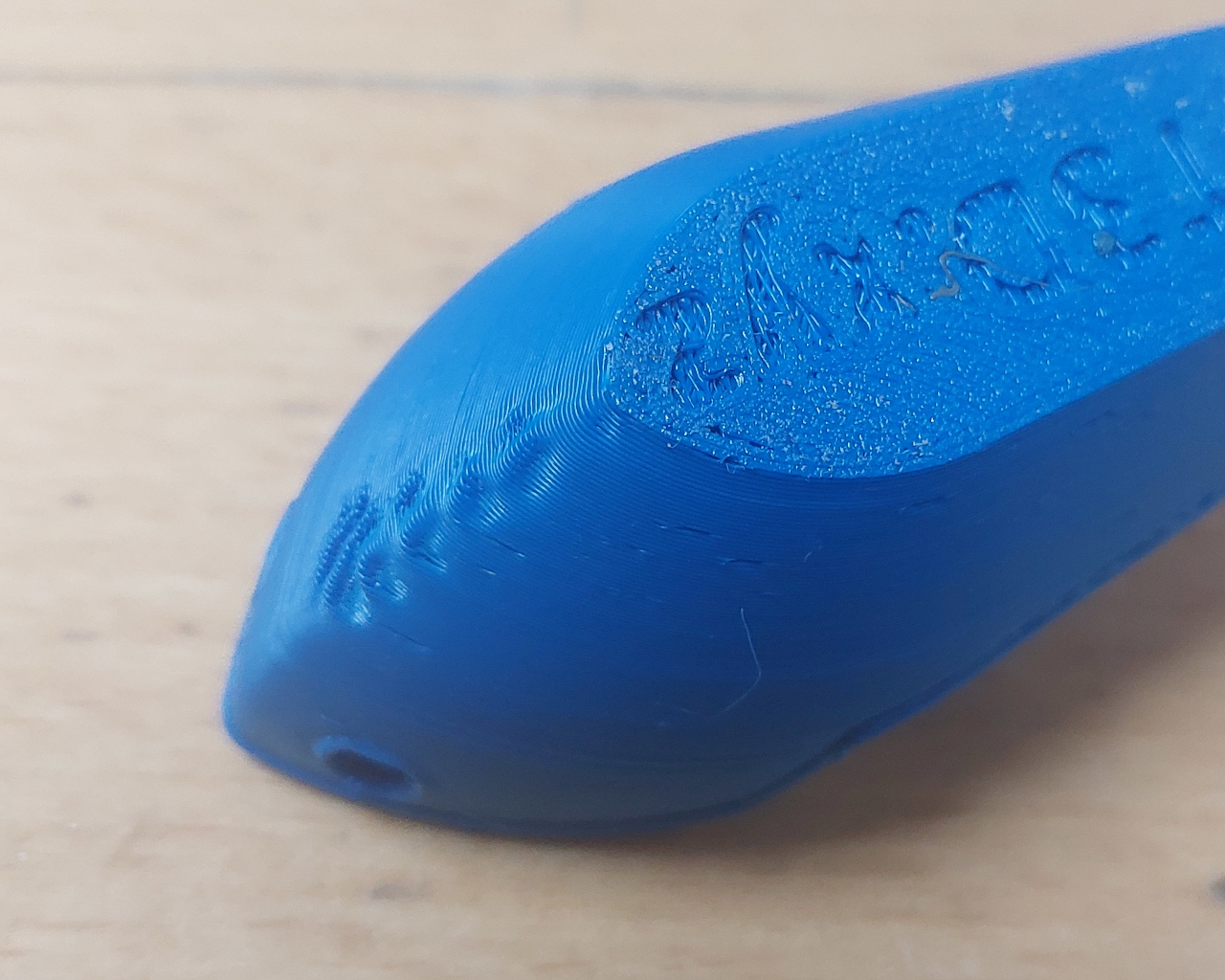
My first surprise on printing the Benchy is that it’s a pretty good print. Received Opinion tells me that PLA is hydrophobic, and if you leave some out for a decade it will absorb so much moisture as to be unusable. In fact I was expecting a very stringy print indeed because I’ve seen that before with filament left out for about a year in the damp British climate. But this Benchy had almost no hairiness, its only flaw was a little bit of collapse along its prow line. I know the Mini isn’t at fault here as I’ve seen it print a flawless Benchy with new PLA, so that’s strike one to the ancient plastic.
Manipulating the Benchy, I found strike two. This is a reasonable print, but with not-too-hard pressure on the cabin I could snap it. The layer adhesion wasn’t as much as it is with a new-filament Benchy, and it has broken cleanly along the layer lines in the cabin pillars. Since snapping a Benchy isn’t a quantitative measure of how much the layer adhesion had degraded, I decided to formulate a test for layer adhesion. If I print something designed for measuring layer adhesion failure in both this old PLA and some new PLA, I can compare the two. It’s not perfect as I don’t have a new reel of the same formulation as the old stuff, but it’ll be close enough.
Punishing Prints, And Risking Holes In The Floor
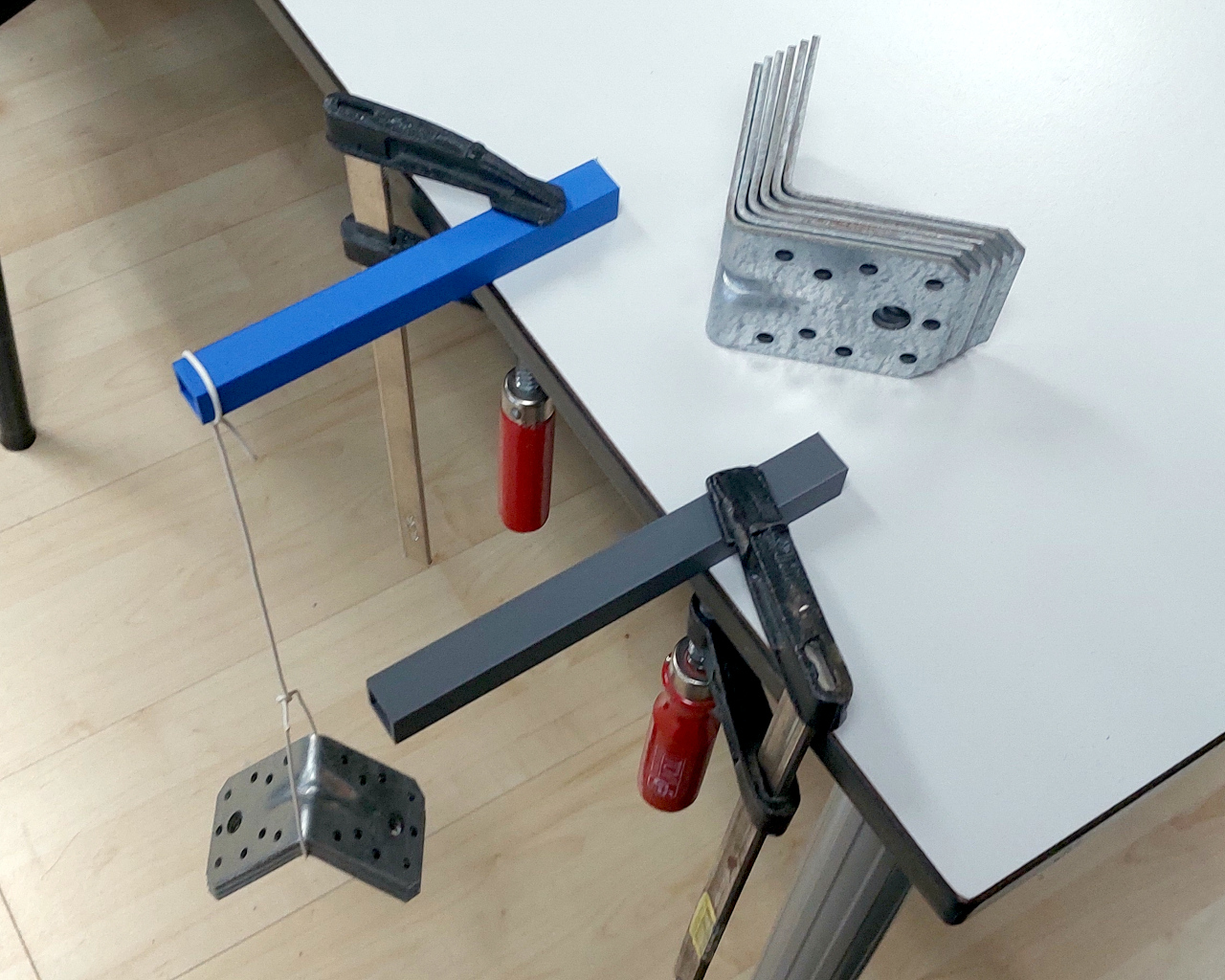
What I have come up with is a 150 mm long box section with a 2 mm wall. If I clamp the first 5 0mm to the edge of a table, I can apply a force to the far end of the 100 mm poking out into free space, and find its breaking point. To that end I’ve printed two, one in my blue old PLA, and another in brand new grey PLA. I’m dangling a collection of angle brackets each of which weighs 130 g from the end of the box section, and adding brackets until it breaks.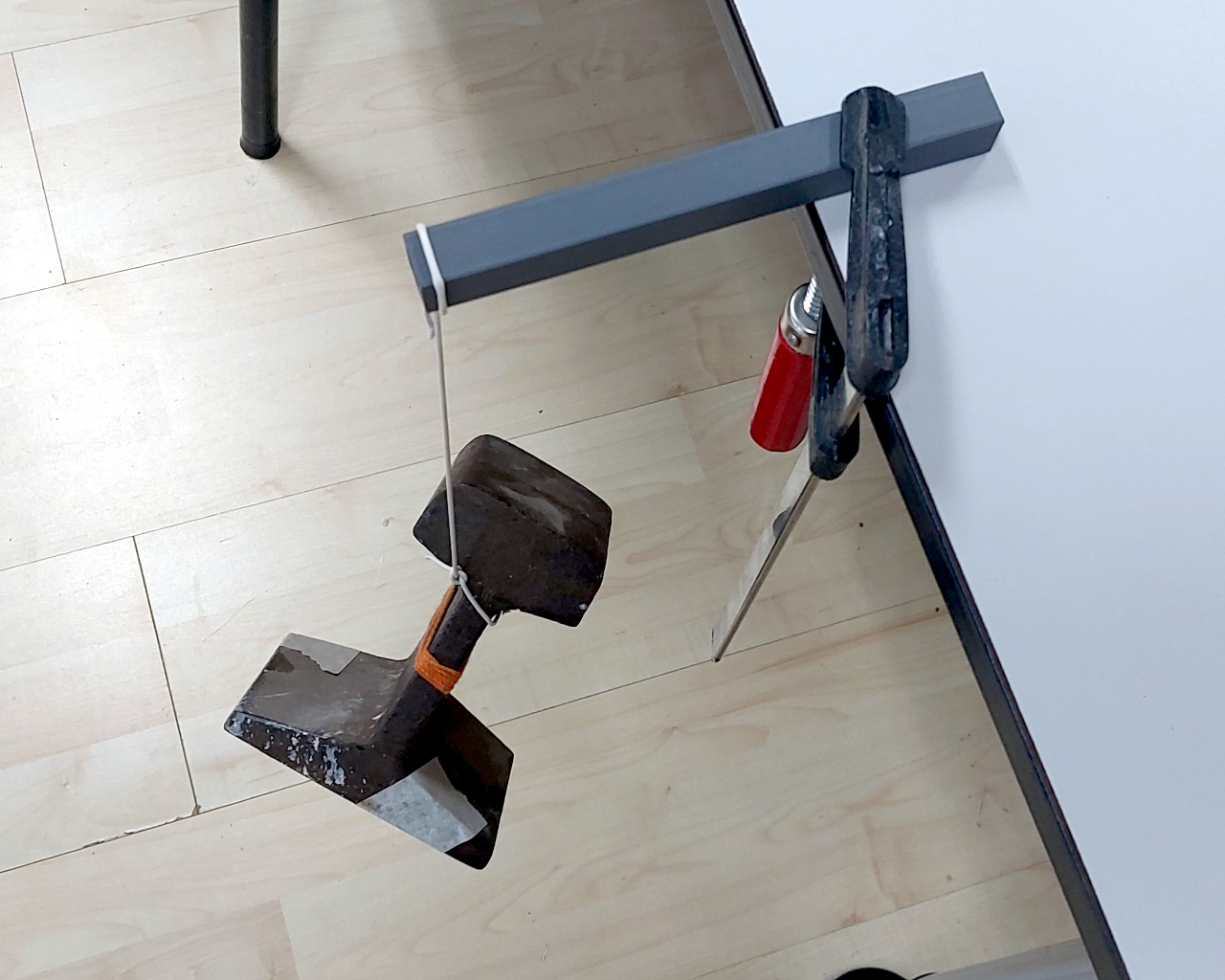
I had only twenty brackets, and as expected the old PLA broke first, at ten brackets, or a 1.3 kg load. My back of the envelope calculation from high school physics gives me about a 130 N force on the top edge of the layer boundary over the fulcrum on the edge of the table to do this. I ran out of brackets and other hardware to try to break the grey box section, and finally admitted defeat when it refused to break with a 3 kg piece of rail I’ve been hoarding to make an anvil dangling from its end. I have proved that layer adhesion with ancient PLA is more than three times weaker than on the same printer with new PLA. It’s interesting when examining the break, the layers have parted very cleanly, this is not tearing of the PLA but simply poor adhesion between layers.
In doing these experiments I’ve discovered, not unexpectedly, that ancient PLA isn’t as good as new PLA. I am assuming that this was as good a PLA as the modern stuff when it was new — indeed I remember printing back in the day and my prints seemed just as good as today. What does surprise me though is that how it’s deteriorated isn’t what I expected. It produces good prints in terms of their physical form, without the hairiness I was expecting. In turn I didn’t expect the prints with this stuff to be weak, so what’s going on?
When The Volatiles Depart, What’s Left?
PLA filament is not pure PLA, instead it has chemicals added to modify its properties. The most obvious one in this reel is the blue pigment, but others might modify its plasticity or melting characteristics, to name two possibilities. These are not going to be stable solids like the polymer, instead they will be volatile compounds which are capable of evaporating over time.
I’m no polymer chemist, so I’ll draw my engineer’s conclusions here and prepare for a roasting from the chemists if I’m wrong. What I think has happened is that the volatile additives in the filament have departed over the years, and both the stringiness in damp newer PLA and the strength in prints made with new PLA are as much due to their presence or absence as to the PLA itself. In my tests here I think I have seen something closer to PLA alone with the additive chemistry absent, and along the way I may have touched on why the manufacturers add it in the first place.
It’s likely few of you are printing using ancient PLA, so while interesting, these results have limited direct relevance to your printing. But I have to wonder whether there’s a lesson to be learned in filament storage, and perhaps using a warm environment to stave off moisture might hasten the departure of those volatiles. Perhaps the best thing is not to be a hoarder, and to use your filament up as quickly as you can. Meanwhile, this isn’t the first time we’ve ventured into backyard physical measurements.

ReMemory is the Amnesia-hedging Buddy Backup You Didn’t Know You Needed
What would happen if you lost your memory, even partially? With so much of our lives being digital, forgetting your passwords (or the master key to your password manager) could be disastrous. Haunted by that specter after a concussion, [eljojo] created ReMemory, a tool based on Shamir’s Secret Sharing to help your friends help you.
Shamir’s Secret Sharing, for the uninitiated, is a way to split up important data between parties so that the full picture is only available when a quorum comes together. The classic example is giving everyone a couple of digits out of the combination to the bank vault, but no one the full combination. Together, they can open the vault.
ReMemory works the same way. Rather than the combination to a bank vault, the locally-hosted, browser-based interface splits the encryption key to your sensitive data. If you’re old fashioned that might be a plaintext list of passwords, or for the more modern the recovery codes to your password manager. It could be literally anything, like your Aunt Edna’s famous cupcake recipe, which surely should not be lost to time.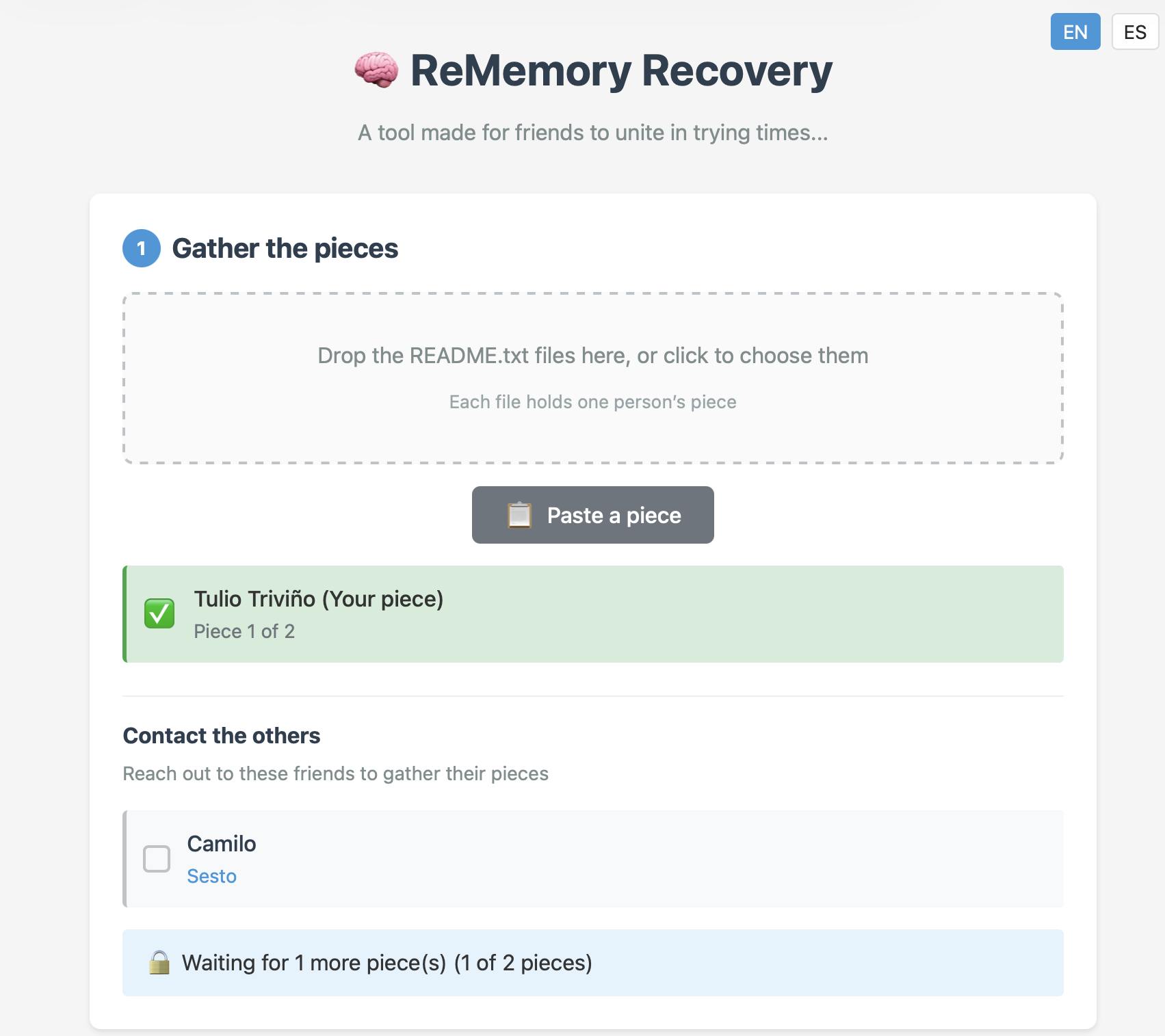
You can chose how many friends to split your data betwixt, and how many will be required to meet quorum– the minimum, of course, being two, but the suggested default is to split the data five ways, and allow decryption from any three parties. Each bundle includes the complete recovery tool, so anyone in your circle of trust can start the process of decrypting your data if they get the others on board. Since it’s self-hosted and browser based, those friends don’t have to be particularly tech-savvy, as long as they can be trusted to hold onto the files. Everything is explained in the readme included in each bundle.
This does have the downside of requiring you to have multiple close friends, at least some of whom you trust to come through in a crunch, and all of whom you trust not to collude behind your back. Still, if you’re the social type, this seems like it might be a useful tool. The code is available under an Apache 2.0 license, so you can audit it for yourself — a must for any tool you plan on entrusting your secrets to.
The best part of the sharing algorithm is that it’s not vulnerable to quantum computing. While [eljojo] was thinking of amnesia when he put the tool together, we can’t help but think this also solves the postmortem password problem.

Gaming on an Arduino Uno Q in Linux
After Qualcomm’s purchase of Arduino it has left many wondering what market its new Uno Q board is trying to target. Taking the ongoing RAM-pocalypse as inspiration, [Bringus Studios] made a tongue-in-cheek video about using one of these SoC/MCU hybrid Arduino boards for running Linux and gaming on it. Naturally, with the lack of ARM-native Steam games, this meant using the FEX x86-to-ARM translator in addition to Steam’s Proton translation layer where no native Linux game exists, making for an excellent stress test of the SoC side of this board.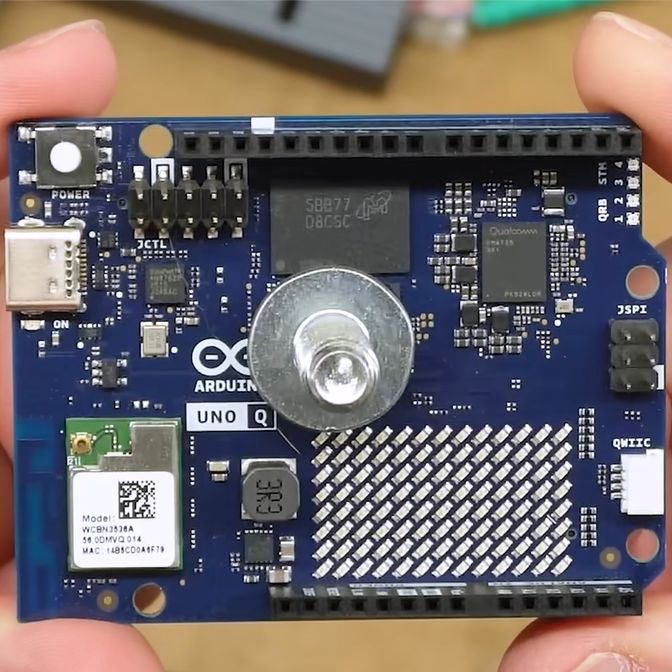
We covered this new ‘Arduino’ board previously, which features both a quad-core Cortex-A53 SoC and a Cortex-M33 MCU. Since it uses the Uno form factor, all SoC I/O goes via the single USB-C connector, meaning that a USB-C docking station is pretty much required to use the SoC, though there’s at least 16 GB of eMMC to install the OS on. A Debian-based OS image even comes preinstalled, which is convenient.
With a mere 2 GB of LPDDR4 it’s not the ideal board to run desktop Linux on, but if you’re persistent and patient enough it will work, and you can even play 3D video games as though it’s Qualcomm’s take on Raspberry Pi SBCs. After some intense gaming the SoC package gets really quite toasty, so adding a heatsink is probably needed if you want to peg its cores and GPU to 100% for extended periods of time.
As for dodging the RAM-pocalypse with one of these $44 boards, it’s about the same price as the 1 GB Raspberry Pi 5, but the 2 GB RPi 5 – even with the recent second price bump – is probably a better deal for this purpose. Especially since you can skip the whole docking station, but losing the eMMC is a rawer deal, and the dedicated MCU could be arguably nice for more dedicated purposes. Still, desktop performance is a hard ‘meh’ on the Uno Q, even if you’re very generous.
Despite FEX being a pain to set up, it seems to work well, which is promising for Valve’s upcoming Steam Frame VR glasses, which are incidentally Qualcomm Snapdragon-based.
youtube.com/embed/YrrqF2y-dlM?…

securityaffairs.com/187848/unc…
#securityaffairs #hacking

Microsoft Patch Tuesday security updates for February 2026 fix six actively exploited zero-days
Microsoft Patch Tuesday security updates for February 2026 fix six actively exploited zero-day vulnerabilities.Pierluigi Paganini (Security Affairs)
MythTV 36.0: il media center open source si rinnova con FFmpeg 8.0
linuxeasy.org/mythtv-36-0-il-m…
MythTV 36.0 è finalmente disponibile! Scopri come il supporto a FFmpeg 8.0 e le nuove ottimizzazioni per Ubuntu 24.04 trasformano la tua esperienza multimediale. L'articolo MythTV 36.0: il media center
Questo sito web utilizza cookie tecnici e di sessione. Proseguendo la navigazione su questo sito, accetti l'utilizzo dei cookie.
nobody
in reply to Jerry 🦙💝🦙 • • •